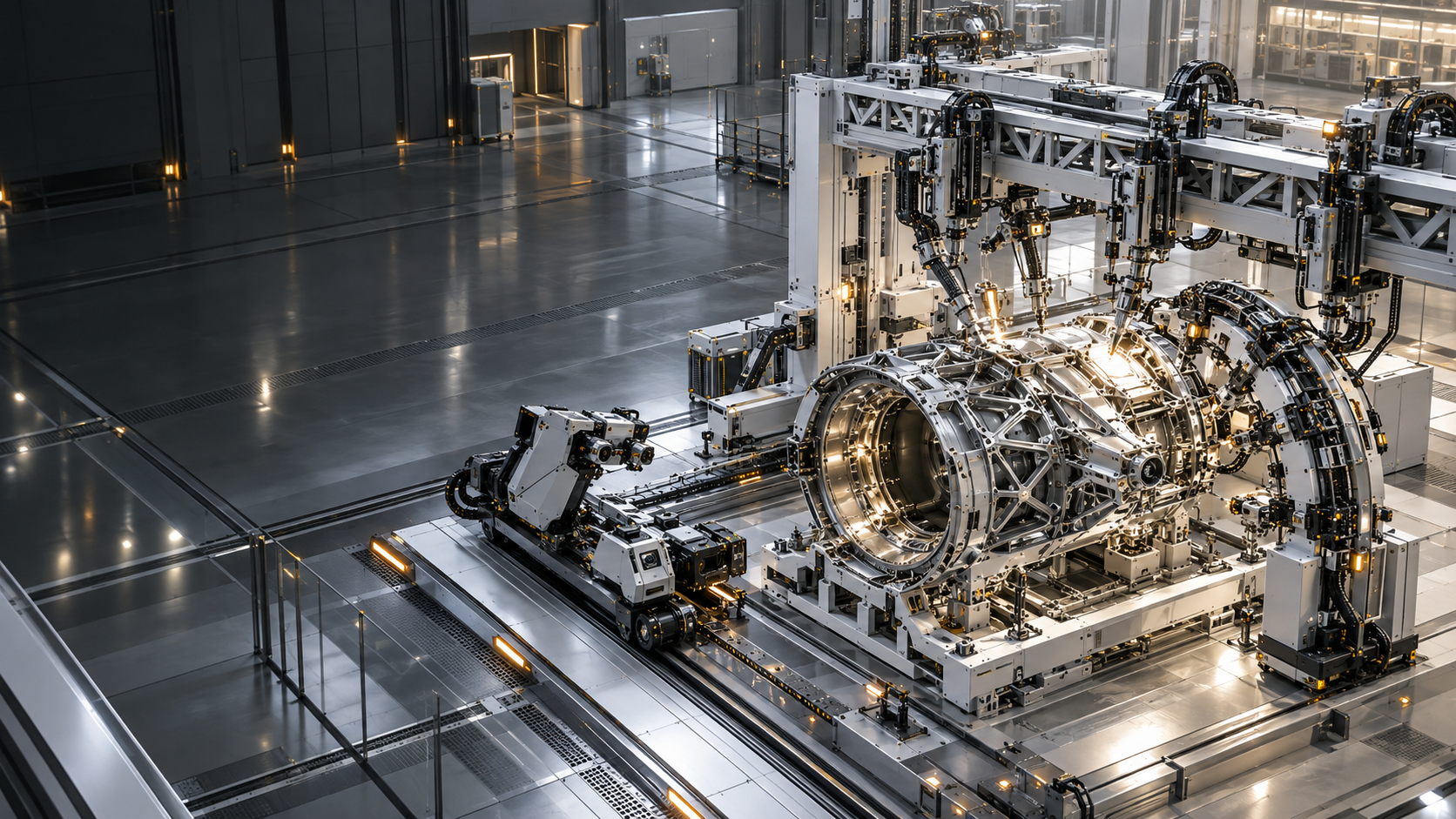
01 / Commission the operating task
Customer authorities define the purpose, environment and acceptance requirements. Programme leadership approves the operating envelope, responsibilities and evidence needed before work begins. Human decisions set the task; autonomous engineering systems develop and evaluate the configuration.
02 / Plan the physical work
Continuum coordinates design models, simulations, material availability and production sequences. It assigns work to specialized machines with the tools, reach and metrology required for the task. A new plan is checked against actual fixtures, access clearances and power supply.
Configuration records connect every design revision to the material, machine state and measurements used to make it. Work holds at an unresolved interface rather than passing uncertainty into the next assembly.
03 / Fabricate, integrate and verify
Anchored manipulators, robotic carriers and inspection cells assemble and test the equipment. Metrology establishes what was built; subsystem tests and integrated trials establish how it behaves. Continuum carries those results into the acceptance record.
Independent technical assurance challenges the design and its test evidence. Executive and customer authorities retain approval of the programme commitment; automated verification is not permission to widen an operating task.
04 / Maintain the deployed configuration
Autonomous service machines inspect equipment, exchange supported modules and diagnose faults. Continuum schedules the work around customer use, replacement inventory, energy and site access. Each completed task updates the equipment record.
If the required part, access or evidence is unavailable, the system reports the constraint and holds the affected operation. Support plans include recovery equipment and safe isolation; they do not assume a robot can reach every location.
Industrial orchestration
Continuum is the common operating system for this work. Business areas supply the vehicle, station or control configuration; Continuum coordinates the autonomous resources that build and support it.